Formalin is one of the threats to the modern world. With the
advancement of the technology, man has discovered the way of preserving
foods for long time. They invented formalin to preserve foods like fish,
fruits, vegetables etc. Earlier, the foods were preserved in natural
ways. But now, the use of chemicals has become a great threat to the
health of mankind. By consuming formalin mixed food, many people die
each year. But if you become a bit careful about this harmful substance,
you can easily get rid of this threat. In this post, I will discuss how
to remove formalin from fruits, fishes & vegetables.
Fruits:
If you suspect that the fruit contains formalin, you must sink it under
water for at least 1hour. Then the formalin will be removed and this
fruits will able to eat.
Vegetables: Vegetables can be ripe by
formaldehyde too. You should sink those under salt water for at least
10minutes before cooking. It will remove the formalin from the
vegetables.
Fishes: Sink the fishes under the water for one hour. It
will remove 60% formalin. If you sink it under salt water for one hour
it can removes 90% formalin will be removed. If you sink fish in 90%
vinegar & 10% water it will remove 100% formalin.
But by
only following this rules our activity won’t finish. We have to take
strict step against them with the help of administration. Otherwise this
problem will increase day by day. We should also encourage other to
stand before this dangerous activity. By this we can get rid from
Formalin.
2.
Written by SHOURAV BARUA
======================= Formalin is a great threat for Bangladesh Agriculture
Do you know what is formalin?? Formalin is a solution in water of the
gas formaldehyde (CH2O). Formalin is a colorless, liquid with a strong
irritating smell, due to the off gassing of formaldehyde. It is this
compound that is mainly responsible for the solution’s chemical
properties. The solution is neutral in terms of acidity and alkaline,
but it can be oxidized to produce formic acid. As it can be oxidized
easily, it is a reducing agent. Strong formalin solutions are flammable,
burning to produce carbon dioxide and water. According to the EPA,
formaldehyde can cause watery eyes, burning sensations in the eyes and
throat, nausea and difficulty breathing in some humans exposed at
elevated levels (above 0.1parts per million). By study it is assure that
it may cause cancer to human. Other health related issues associated
with formaldehyde are skin and/or eye irritation, coughing, vomiting and
diarrhea.
Everyone knows that formalin is a poison. But few
people know how much it is threat for us, our society, and our country.
And now a day’s formalin makes a great threat for our agriculture also.
But many of us ignore this and busy with there work. May be they forget
that Bangladesh is agro based country. May be they don’t want to
remember that we are Bengali by fish and rice. If any one mix poison
with your food what will you do?? You will take a step against it and
object hat it was an attempt to murder. So why you’re not taking any
step now? Tell me who give right to them, to mix formalin (poison) with
food?? Do you ever thought that?? So think now. May be you saw the above
writing. Analyze how much dangerous & worst is formalin. We are not
against formalin. But we are against of them, who use formalin not for
welfare of society. Use only for there self interest. According to me
they are doing a great crime. In one sentence they are murderer. They
are killing quality, taste, value of Bangladesh’s agriculture. According
to them pride of country is not important. People of Bangladesh are not
important for them. Profit is there main motivation. At first they are
taking much price betraying innocent farmer and now are betraying people
of Bangladesh. What they want?? Instead of giving Flowers to motherland
they are giving Formalin. Not a single voice is talking against those
misuses of formalin. No one is stand in front of this problem. At last
we will see that our life become a formalin plus nation. Can’t we do
anything? Yes, we will do something for our nation, our country and for
people of our motherland. So first we have to inform to administration
if we saw applying formalin without license anywhere. Otherwise we can
directly give these types of criminal to POLICE. Government should make
some strict legal aspects for defense this great threat. And most
important saying for us to not underestimate FORMALIN & AGRICULTURE.
And we will stands along them who want to stop this dangerous problem.
Otherwise we can’t live a peaceful life.
AGRICULTURE IN
BANGLADESH
Sheikh Iftekhar.
Bangladesh is a country which is mainly
dependent on its agriculture sector. The agriculture unit is handled by
the hand working farmers of our country. But the farmers aren’t in such a
good position in the society of our country. They cultivate goods and
vegetables and the finished goods then get delivered to the citizens of
the city.
The farmers of our country are one of the most hand working farmers in
the world. Everyday they get up work hard on their fields and they
produce goods and vegetables for selling them in the local market, but
there they don’t get the demanded price they want in their goods.
Instead they got a lot lower amount of profit. They also don’t get the
necessary equipments which they need to develop more and good quality of
goods. The seeds and other items they get supplied with aren’t of that
good quality and the price of those items get increased to such a height
that makes them very difficult to buy. Aside these problems the farmers
work day and night and try to produce the goods so that they can sell
them. They work in the cold, stormy weather and even in the heat but
still they are not appreciated.
The farmers do a lot of hard work for the country and its people. The
least we can do is help them in their long run. We need to start events
and programs that will encourage the young ones in school and homes to
know what type of work the farmers of our country does. We should also
establish fund raising events so that we can help supply the farmers
with advance farming equipment and high quality seeds. We should take
steps that will help the farmers in any ways necessary.
The farmers in our country are the driving force of our great nation.
Their struggle should be admired and respected. We should always try to
help them in anyway possible. Because if they are established than our
country will be established.

3.
Written By Laila Jenifer.
===================
Golden Bangla: Her agriculture & farmers
Laila Jenifer
This world of ours is rich with wealth, grains and flowers,
But in between all these, there is a country which is the best among all countries,
This country is made of dreams, surrounded by memories
You will not find such a country anywhere else
This country is the Queen of all countries, it is my birth land,
My birth land, My birth land!!
Unfortunately, our golden mother land is ill treated by her own off
spring. It made us feel proud we are Bangle once but with the course of
time it’s getting fade. It is saying, the dust of her is gold. Her land
is fertile and normally ample water supply. So in this main reason she
is agriculture based .Nature is very kind to her and enriches Bangla.
But today’s perspective is different for who are the miner here they are
ill paid. As a result, she lost her past glory.
Bangladesh is an
agro based country and farmers are her main driving force. The
foundation of her economy is fully dependent on this sector. Out of
total population of her 80% earn their livelihood from this sector. Rice
and Jute are the primary crops. Vegetables, Poultry, Tea, Wood and
Fishing are the important in agriculture. Besides, she has experienced
cheap labour price which is the lucky charm for the country’s
development. Rice is the staple food of about 135 million people of
Bangladesh. It provides nearly 48% of rural employment, about two-third
of total calorie supply and about one-half of the total protein intake
of an average person in the country. Rice sector contributes one-half of
the agricultural GDP and one-sixth of the national income in
Bangladesh. Almost all of the 13 million farm families of the country
grow rice. Rice is grown on about 10.5 million hectares which has
remained almost stable over the past three decades. About 75% of the
total cropped area and over 80% of the total irrigated area is planted
to rice. Thus, rice plays a vital role in the livelihood of the people
of Bangladesh. Total rice production in Bangladesh was about 10.59
million tons in the year 1971 when the country's population was only
about 70.88 millions. However, the country is now producing about 25.0
million tons to feed her 135 million people. This indicates that the
growth of rice production was much faster than the growth of population.
This increased rice production has been possible largely due to the
adoption of modern rice varieties on around 66% of the rice land which
contributes to about 73% of the country's total rice production.
In a
glimpse let’s go inside the whole atmosphere of her economic base.
Bangladesh has a primarily agrarian economy. Agriculture is the single
largest producing sector of the economy since it comprises about 30% of
the country’s GDP and employs around 60% of the total labor force. The
performance of this sector has an overwhelming impact on major
macroeconomic objectives like employment generation, poverty
alleviation, human resources development and food security. People here
earn their living from agriculture. Mainly rice and jute are cultivated
here. Due to the expansion of irrigation networks, some wheat producers
have switched to cultivation of maize which is used mostly as poultry
feed. Tea is grown in the northeast. Fertile soil and normally ample
water supply, rice can be grown and harvested three times a year in many
areas here. Due to a number of factors, Bangladesh’s labor-intensive
agriculture has achieved steady increases in food grain production
despite the often unfavorable weather conditions. These include better
flood control and irrigation, a generally more efficient use of
fertilizers, and the establishment of better distribution and rural
credit networks. With 35.8 million metric tons produced in 2000, rice is
Bangladesh’s principal crop. National sales of the classes of
insecticide used on rice, including granular carbofuran, synthetic
pyrethroids, and Malathion exceeded 13,000 tons of formulated products
in 2003. The insecticides not only represent an environmental threat,
but are a significant expenditure to poor rice farmers. The Bangladesh
Rice Research Institute is working with various NGOs and international
organizations to reduce insecticide use in rice.
With 28.8 million
metric tons produced in 2005-2006 (July-June), rice is Bangladesh’s
principal crop. By comparison, wheat output in 2005-2006 was 9 million
metric tons Population pressure continues to place a severe burden on
productive capacity, creating a food deficit, especially of wheat.
Foreign assistance and commercial imports fill the gap, but seasonal
hunger (“monga”) remains a problem. Underemployment remains a serious
problem, and a growing concern for Bangladesh’s agricultural sector will
be its ability to absorb additional manpower. Finding alternative
sources of employment will continue to be a daunting problem for future
governments, particularly with the increasing numbers of landless
peasants who already account for about half the rural labor force. Due
to farmers’ vulnerability to various risks, her poorest face numerous
potential limitations on their ability to enhance agriculture production
and their livelihoods. These include an actual and perceived risk to
investing in new agricultural technologies and activities, a
vulnerability to shocks and stresses and a limited ability to mitigate
or cope with these and limited access to market information.
Jute, often called the "golden fibre" of Bengal, is the main
export-earner for Bangladeshi agriculture, as Bangladesh remains the
world's second-largest producer of jute (after India) and the world's
largest exporter of fiber. Jute is traditionally used for the fiber of
carpet backing, burlap bags, cheap paper, and various other purposes.
Its importance for the Bangladeshi economy comes from the fact that
almost 3 million farms are involved in jute production. In 1999
Bangladeshi export earnings from jute amounted to US$55 million, with
the country producing 720,000 metric tons of jute, although this is
about one-third of the jute production of the middle of the 1980s. The
decline in jute production is attributed to declining world prices for
this crop and to farmers switching to other crops.
Bangladesh
also produces tea leaves, mainly for export, although the export of this
product contributes only 1 percent of the country's hard currency
earnings. In 1998-99 the country produced 56,000 metric tons of tea
leaves, but it could produce twice that amount. The main obstacle to
increasing production is in falling prices for tea in the international
market and in management and regulation problems in the industry in the
country.
Wheat is not a traditional crop in Bangladesh, and in
the late 1980s little was consumed in rural areas. During the 1960s and
early 1970s, however, it was the only commodity for which local
consumption increased because external food aid was most often provided
in the form of wheat. In the first half of the 1980s, domestic wheat
production rose to more than 1 million tons per year but was still only 7
to 9 percent of total food grain production. Record production of
nearly 1.5 million tons was achieved in FY 1985, but the following year
saw a decrease to just over 1 million tons. About half the wheat is
grown on irrigated land. The proportion of land devoted to wheat
remained essentially unchanged between 1980 and 1986, at a little less
than 6 percent of total planted area Wheat also accounts for the great
bulk of imported food grains, exceeding 1 million tons annually and
going higher than 1.8 million tons in FY 1984, FY 1985, and FY 1987. The
great bulk of the imported wheat is financed under aid programs of the
United States, the European Economic Community, and the World Food
Programmed.
Food grains are cultivated primarily for subsistence.
Only a small percentage of total production makes its way into
commercial channels. Other Bangladeshi food crops, however, are grown
chiefly for the domestic market. They include potatoes and sweet
potatoes, with a combined record production of 1.9 million tons in FY
1984; oilseeds, with an annual average production of 250,000 tons; and
fruits such as bananas, jackfruit, mangoes, and pineapples. Estimates of
sugarcane production put annual production at more than 7 million tons
per year, most of it processed into a coarse, unrefined sugar known as
gur, and sold domestically.
In the era of free economy,
Bangladesh like many other countries, adopted a liberalized trade policy
in the food grain sector. This facilitated the private sector to play
an important role in augmenting the supply of food grain in the market
and thus stabilizing the market prices. Private sector has been playing a
vital role in food grain market since the inception of the private
sector grain trading in early-1990. The government did not require to
import any food grain by its own resources for the years 1999/00 to
2002/03 as the domestic supply was smooth through private sector import.
Total food grain import in the fiscal year 2007-08 as mentioned in the
food situation report from the government Food Planning and Monitoring
Unit/FPMU was 3.47 million metric tons against 2.42 million metric tons
in 2006-07. Of this amount, 2.06 million metric tons was rice and the
remaining 1.41 million metric tons was wheat. Private import constituted
84% of total import of which 58% was rice and 42% was wheat. There was
296 million metric tons of commercial/ public import of rice by the
government but there was no such government import of wheat in 2007-08.
The increased import of rice in 2007/08 was to compensate for the loss
of rice production due to flood and cyclone. The government had to
import more food grains in 2007/08 to recover the short fall in domestic
procurement and to meet the increased requirement for PFDS,
particularly resulting from the flood and cyclone in 2007. The
projection for total food grain import in the fiscal year 2008/09 is
3.13 million metric tons of which 1.07 million metric tons rice and 2.06
million metric tons wheat.
Bangladesh produces aromatic fine
quality rice in small scale such as kalijira, chinigura, kataribhog
badshabhog etc. Although this rice is mostly consumed within the country
at a very high price, a part of it is exported for which the major
consumers are the ethnic Bangladeshi community living in different
countries of the world. According to the information received from the
Rice Exporters Association of Bangladesh, a total of 10,000 and 8,500
metric tons of aromatic fine rice were exported in 2006 and 2007
respectively mainly to USA, UK, Canada, Italy and some middle-eastern
countries.
How are they who work day- night to feed us?
Bangladesh is an agricultural country. Over 80% of Bangladesh's
workforce is rural, yet the vast majority is extremely poor, illiterate
and politically marginalized. Farmers are the life of our nation. They
supply food for us. They are self-employed. In this way they are solving
our unemployment problem. They are leading an important role of our
economic but they live under the poverty level. The food grains they
produce are essential for us but they don’t have good food, shelter or
cloths. They are honest, sincere, simple and gentle. They struggle hard
to live their life. Poverty is their constant companion. These farmers
live in harsh and degrading conditions, earning a pittance working for
landlords. Their situation is worsened through an absence of political
and social awareness and a lack of capacity to defend their rights. As a
result of this they are often exploited and oppressed. Women face an
even more difficult situation due to the persistence of conservative
religious structures that serve to oppress women, and LRC works to
increase women's awareness and rights and campaigns to eliminate the
discrepancy between treatment of women and men. However, they are happy
souls with all their sufferings. They are God fearing. They accept it
without complaint to God. Hardship of their life not dried up their
smile, kindness, love, affection and sympathy. Sometimes they are seen
working all over the night. For refreshing or forgetting their tiredness
or pains a they sing melodious song like Baul song, Bhatiali, Bhawaiya,
Marfuti and murshidi. It makes our environment charming. Even they are
poor, they are very nice and hospitable. If you ask for a glass of
water, they will bring it and often with something extra to go with the
water. They enjoy and share the happiness with everyone. The farmers
arrange a party for getting new crops. This party called as ‘Nobanno
Utshob’ (Festival of foods made by new paddy). In this party the farmers
welcome their neighbors and guests by chira, murri and many kinds of
pittha. In this way they celebrate their ‘Nobanno Utshob’.
Life
is possible where there is a will. Golden Bangla has potentiality in
this sector. Her people know how to fight back and survive. We are
having lacking, discriminations, political violence, ups and downs even
though there is a light of hope. Now time to look back what we have and
how to implement those precious potential factors. Have a look on the
positives side of our agriculture:
1. Having competent and versatile human resources
2. Having a well-set up professional man power
3. Working with groups
4. Possessing generally adequate physical facilities including a network of local offices
5. Farmers training center
6. Diversified available technologies
7. Follow up planning
8. Location specific agricultural knowledge of ext. officers.
9. Environmental awareness particularly Integrated Soil fertility & pest worker
10. Human resource development institute (ATI & CERDI)
11. Competence in a wide range of extension methods
Apart from these we are having some sort of draw backs:
1. In adequate communication
2. Lack of incentives for efficient extension worker
3. Lack of expertise and institution to prepare extension material for the users.
4. Lack of appropriate technologies for char (Sandy / Land)
5. Lack of Raw material
6. Lack of awareness
7. Natural Calamity (Flood, Cyclone, Heavy Raining etc)
The foundation, in short we can assume, of our economy is agriculture
and its backbone is farmer. Therefore top most priority must be given to
this sector. Various programmers for the improvement of agriculture are
taken different time by different body but it is the high time to think
in wide angle. Our Agriculture is now in the process of transformation
from subsistence farming into commercial farming. We have already
entered into the European Market for export of vegetables and other high
value crops. This process opens a vista to private sector investment in
the areas of production of high value crops, production of seeds of
chemical and blended fertilizers, agro-processing enterprises, etc.
Finally, for longer term growth, well-designed management of the water
resources is absolutely essential and will be particularly important for
adaption to climate change.
Ref:
• Different survey
• On line journals
• Newspaper clippings
• Photo Collected
4.
Written by:- Bishal Barua.
=====================
Bangladeshi village farmers
Bangladesh is an agriculture dependent country. Most of the people live
in villages. A large number of them are occupied with agriculture and
they earn their living from agriculture. The people that are involved
with agriculture are called farmers. Once, jute, rice and some selected
crops were preferred by farmers to deal with. But now a days the
Bangladeshi village farmers has find out an expanded area to work with.
Now farmers have several sites to work and they are showing a
mentionable performance at their own workplace.
Bangladeshi village farmers have some categories. They are:
Crop farmers
Vegetable farmers
Fruit farmers
Flower farmers
Fish farmers
Poultry farmers
Dairy farmers
Nursery farmers
Crop farmers
Bangladesh is a country of fertile land. There are many rivers, canals,
streams and lakes all over the country that’s why this country is
suitable for cultivation. From a long ago the Bangladeshi village
farmers are familiar with crop cultivation. In those days also there
were two types of farmers – agrarians and landless. Both types are
visible till now in villages. The first one gets the larger part of the
crop because of their land ownership. The second one though gives hard
labor, though after that they live a miserable life. In the very
northern area of Bangladesh a short timed famine is seen every year.
Vegetable farmers
Many Bangladeshi village farmers are now showing their interest in this
project and doing also well. Vegetables were not cultivated
commercially before. But now lots of areas are covered with vegetable
field. Government and some NGOs are showing the technique of proper
irrigation and how to decrease the uses of insecticide.
Fruit farmers
For the last few years Bangladeshi village farmers are showing their
success in fruit field. Bangladeshi agricultural research sector are
also helping them in this field by giving them new invented plants of
much growing fruits.
Flower farmers
Now a days Bangladeshi
village farmers are also doing well in flower cultivating. They are now
producing various types of flowers that are sold in the flower markets.
The increasing demand for flowers has inspired them to take this step. A
lot of people are occupied with flowering sector.
Fish farmers
Once there was a time that the Bangladeshi people’s demand for fish
could be fulfilled by the fish that the fishermen caught from natural
reservoirs. But now the situation is much more changed. Unplanned
fishing, using current net for fishing, use of poisonous chemical
insecticides has driven the reservoirs inappropriate for growing more
fish and to fulfill the demand for fish. As a result, for the growing
population’s fish supply now Bangladeshi village farmers has started to
produce fish commercially.
Poultry farmers
Poultry farming
is a very familiar sector in Bangladesh. The Bangladeshi village farmers
have shown their mentionable activity in this sector. There is not so
much difficulties to run a poultry farm. It only takes a hard labor and
attention to keep a poultry farm running. Many village families have
changed their economical condition by starting a poultry farm.
Dairy farmers
Dairy farm is one of the old farming in Bangladesh. From the very
beginning Bangladeshi village farmers used to keep up cows and goats as
domestic animals. They also used the cow to plough their land for
cultivation. But now the government and some NGOs are inspiring village
farmers to keep high quality cows and goats and as a result they are
able to change their life style by the profits that come from the
dairies.
Nursery farmers
“Plant trees – save the world” –
this is the slogan to save the environment as well as to save the
country. Unplanned tree cuts, rapidly growing population, cutting trees
to establish factories and housings all these are pushing the country at
a risk of natural disaster as well as global worming. To prevent these
types of disasters it needs.
5.
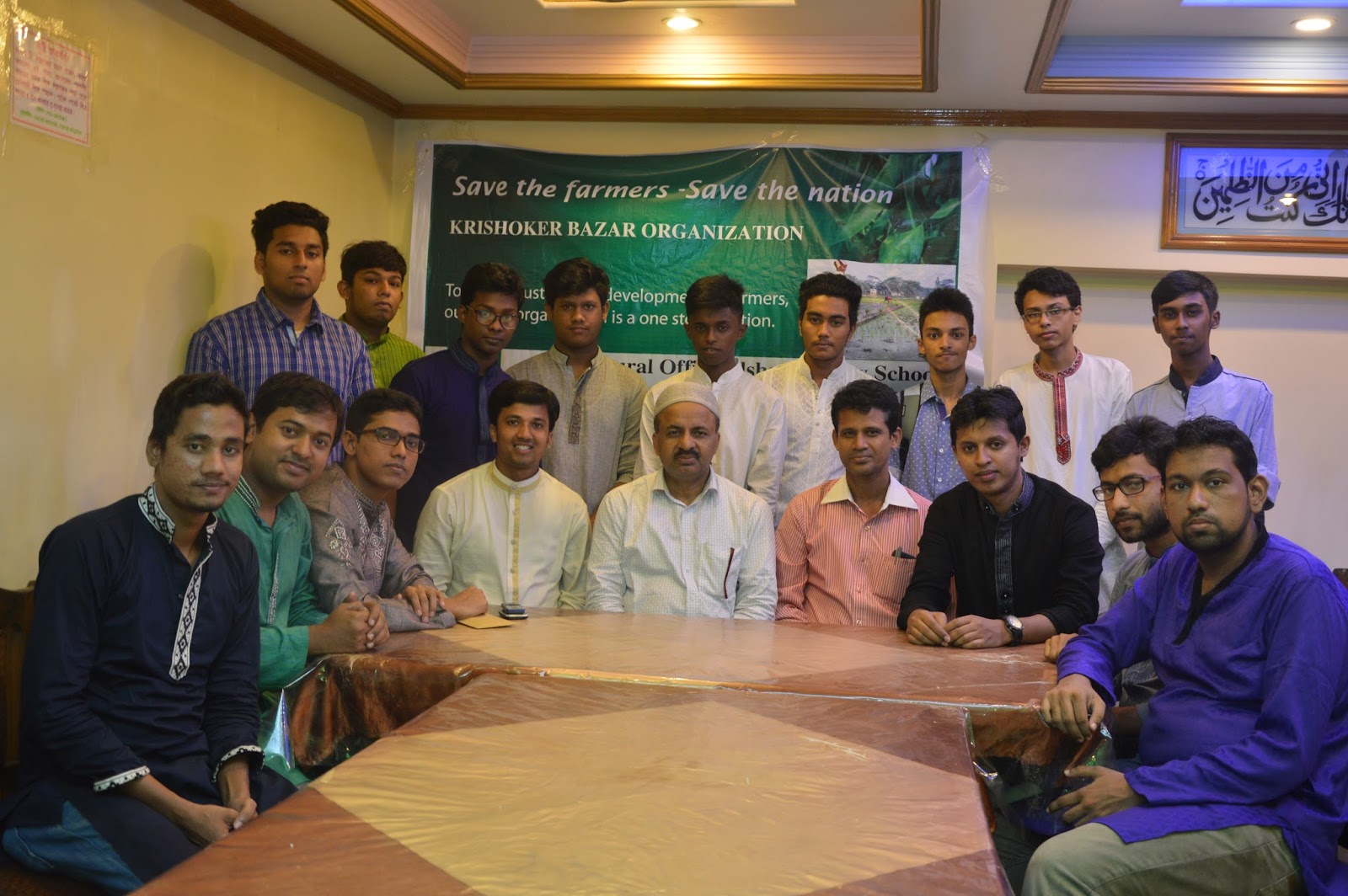
Krishoker Bazaar Organization’s Team.
================================
Written by Krishok Bondhu
In our organization there is great camaraderie among the members of the
team. It is a voluntary in nature lout the members are performing as
professional executives. The team members seemed amenable to my all
suggestion. The general members are cordial in nature. There are no
misconceptions among the members because of our organized authority and
our own constitution. But it is a matter of sorrow that there is a
lack
of perception about social business. I want to share save documents
with my members which are narrative in nature I hope that there will be
an efficient team work which will increase our face value. We have to
trust our team effort and work sincerely. The arrangement of our next
activities will be maintained in such a way that every member will be
able to participate and enjoy the moment. We want to enjoy the spending
time with our team members and want to increase our team members whose
are affable in nature. At this time I want say that, there are some
risks in developing our team as a legal authority. Chittagong is our
base and we want to expand our branches in Chittagong and Dhaka
division. In near future, we will set our organizations many countries.
We need some international members. I hope that we all work for reducing
poverty and ensure a sustainable development for the farmers and make
the youth as a green consumer. Special thanks to the executive members.
6.
Written By :- Emad Hossian
=========================
AGRO - business in Bangladesh
The demand for food in Bangladesh and around the world is changing
rapidly. Driven by economic growth, rising incomes and urbanisation,
demand is shifting away from traditional food to high-value food
commodities. High value agricultural commodities include fruits,
vegetable, spice, fish and live stock products. In Bangladesh additional
demand for those commodities is projected to be worth about
$8 billion by 2020.Agro business also provides and opportunity to
generate rural employment and raise rural incomes. More than 80% of
people living on less than $2 a day in Bangladesh live in rural areas.
This aspitial distribution of poverty makes capitalising on the
opportunities afforded by high value agricultural production is
important for reduce poverty makes capitalising on the opportunities
afforded by high value agricultural production is important for reduce
poverty in the country. A new report published by the world bank and the
IFC-SEDF, entitled high value agriculture in Bangladesh, examines the
opportunities and constraints that Bangladesh agro-business face in
shifting to this type of production. The report present care studies of
five high value agricultural industry they are: aquaculture, small-scale
commercial poultry, fruits and vegetable, high value aromatic rice and
dairy. Bangladesh’s strong comparative advantage in fish production,
together with burgeoning domestic and foreign demand for fish products
make aquaculture an industry of tremendous potential growth, yet,
quality problems and low productivity could blunt the competivenes of
shrimp export industry. Bangladesh’s poultry industry .Bangladesh’s
poultry industry, where rapid growth in the last 15 years has been
concentrated among large, well-established commercial enterprise
consumption of fruits and vegetable is growing in Bangladesh. Yet,
limited availability of planting material and hybrid seeds keeps
productivity low. Farmer needs better market information to synchronize
production with demand. The performance of Bangladesh fruit and
vegetable exports is unlikely to improve unless specific steps are taken
to ensure long term growth.
7.
Written By M.A Noman
=======================
Agro Business in Bangladesh
Bangladesh is widely known as an agro based country, blessed by both
nature and strategic location. The propensity of our economic growth was
always inclined towards agro sector though it was not seriously looked
at for long time. Bangladesh has both potential as well as severe
challenges for agricultural production food processing and food
security. It has an overwhelming agricultural economy. Agriculture
accounts for 32% of its gross domestic product (GDP) and absorbs 63% of
the country’s labor force. Economic growth, rising incomes and
urbanization are combining to shift food demand away from traditional
staples and toward high-value foods.
The economy of Bangladesh is
primarily dependent on Agriculture. About 84% of total population lives
in rural areas and are directly or indirectly engaged in wide range of
agriculture activities. Agriculture contributes about 15 to20% to
country’s GDP. About 43.6% of the labor force is employed in agriculture
with about 57% being employed in the crop section.
We know that there are three kinds of industry not only in Bangladesh but also in all over the world. They are:-
1) Primary Agriculture= Poultry, Mining, Fishing etc.
2) Manufacturing (Production)
3) Tertiary (Service)
In primary industry agriculture is the main sector in Bangladesh, which contributes more than 15% to GDP per year.
There are many companies in Bangladesh doing business based on agriculture.
The name of agriculture based company in Bangladesh is described below:-
1] Ahmed agro agency:-
Address: Elite house (3rd floor) 54, Motijheel C/A.
Sector: Agriculture product seller, crop care product in retail packs (pesticides, PGR, Fertilizer).
2] Barkat Traders:- B-174-76-Gulshan.
3] Bionic Fish processing Ltd: Garib Newaz clinic building KDA Avenue, Khulna-9100.
Sectors: processing and avoids fish in domestic international market.
4] Borak Trade International: Address: Zaman chanba, 47, dilkhasha C/A (2nd floor)
Sector: Export good quality of frozen fish like shrimp and fruits.
There is a wide variety of investment opportunity including:
*cold storage facilities serving the supply chain, especially fresh produce for export.
*Fresh produce production for local and export markets.
*Production of fertilizer and cultivation of seeds.
*Eco-friendly jute production, supported by jute technology development institutes.
*shrimp farming
*Halal foods
*milk and dairy products
*High value added food for export, including herbs, spices, nuts and pulses.
Despite growing domestic consumption of fruit and vegetables, the
production, processing and marketing of fruit and vegetables have
suffered because improvements in productivity, post harvest technology
and infrastructure for the domestic market have been greatly neglected.
The variable performance of Bangladesh’s fruit and vegetable export is
unlikely to improve unless specific steps are taken to ensure long term
growth. There are nearly 700 processed food manufacturing enterprises in
the country. These include processing of bakery confectionary, fruits
and various other food products. More than 100 horticultural crops are
exported from Bangladesh. Exports of fresh fruits and vegetables from
Bangladesh increased from 9000 tons in 1992-93 to 48428 tons in
2010-2011.The major export market comprises UK (46%),Italy (8%), other
EU countries(3%) and middle East countries (43%).Besides, fresh fruits
and vegetables, frozen products about 250-300 tons at a value of about 3
million US $ are exported for both ethnic and ex mainstream markets.
There is a lot of innovation in the mobile, I.T, and energy spaces that
have the potential to make a huge impact on the farm. For example,
smart power system, precision agriculture tools, farm management
software, and affordable sensors are all within reach of even the
smallest farmers today. Two of our portfolio companies, slim trader and
promethean power, deploy their technologies with farmers.
Formaldehyde (formalin) is a toxic substance illegely used by merchants
to preserve food, to make these look fresh and attractive in the market
for longer periods of time, thus maximising profits.
The government is trying to to enact necessary law as well as impose restriction on import and on many chemicals –
*Mailbag bazaar has been declared the city’s firm formalin free kitchen
market. Then, Shominagar as the 2nd formalin free kitchen market.
According to Daily star-July 2, 2013 United food safety authority on
cards, cabinet okays drafts law with provision for foods courts,14 years
jail for food adulteration.